Why Is Rwanda an Expensive Destination?
August 11, 2026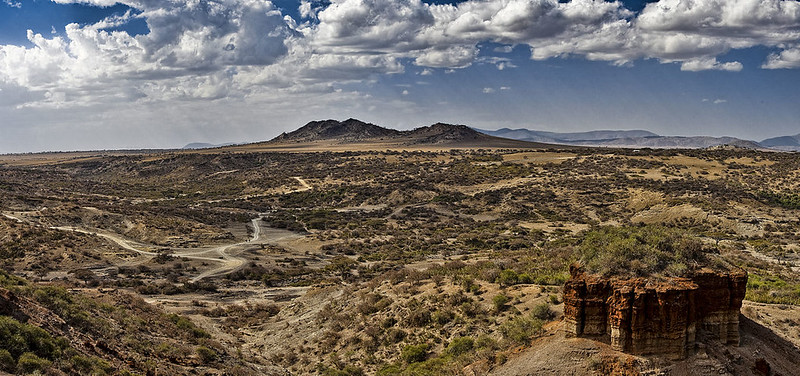
Few regions on Earth pack as much human history into one landscape as East Africa does. This corner of the continent holds the footprints of our earliest ancestors, the ruins of Swahili trading empires, and rock-hewn churches carved by hand centuries ago. If you love history, the archaeological sites in East Africa deserve a permanent spot on your travel list. Below, Zamunda Travels breaks down the ten most remarkable locations, why they matter, and how you can experience them yourself.
Why Archaeological Sites in East Africa Deserve a Spot on Your Bucket List
East Africa sits at a rare crossroads. The Great Rift Valley preserves millions of years of human evolution in volcanic ash and sediment. Meanwhile, the Swahili Coast tells a completely different story: one of medieval trade, Islamic architecture, and cultural exchange between Africa, Arabia, and Asia. Ethiopia adds yet another layer, with ancient kingdoms and rock cut churches that still function as places of worship today. Because of this diversity, a single trip through the region can take you from the dawn of humankind to a thriving 14th century trading port in only a few days. Zamunda Travels designs itineraries that connect these dots, so travelers don’t have to piece the story together alone.
The Top 10 Archaeological Sites in East Africa
1. Olduvai Gorge, Tanzania — The Cradle of Humankind
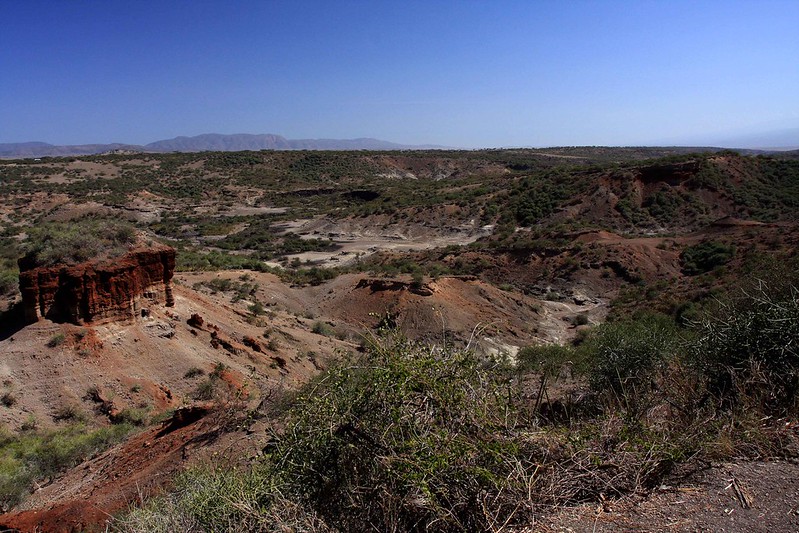
Olduvai Gorge sits inside the Ngorongoro Conservation Area in northern Tanzania, and many researchers consider it the single most important paleoanthropological site on the planet. Archaeologists Louis and Mary Leakey began excavating here in the 1930s, and their work eventually uncovered fossils from more than 60 hominins. These finds provide the most continuous fossil record of human evolution over the past two million years, along with the longest known record of stone-tool development anywhere in the world. UNESCO recognized the gorge as a World Heritage Site in 1979. Today, visitors can walk through the on site museum, view active excavation areas, and stand in the exact ravine where the Leakeys changed our understanding of human origins. Consequently, most travelers pair a stop at Olduvai with nearby Ngorongoro Crater and the Serengeti, and Zamunda Travels regularly builds this combination into its northern Tanzania safaris.
2. Laetoli, Tanzania — Footprints That Rewrote Human History
Just 45 kilometers south of Olduvai lies Laetoli, home to one of the most astonishing discoveries in paleoanthropology. In 1976, Mary Leakey’s team found animal tracks fossilized in volcanic ash. Two years later, researcher Paul Abell uncovered a 27-meter trail containing roughly 70 hominin footprints, now dated to about 3.6 million years old. The prints almost certainly belong to Australopithecus afarensis, and they offer the clearest early evidence that our ancestors walked upright long before their brains grew large. Because the original trackway is fragile, conservators reburied it for protection, so visitors instead view detailed replicas at the Olduvai Gorge Museum. Even so, standing near the site and learning the story firsthand adds a layer of meaning that no textbook can replicate.
3. Koobi Fora, Kenya — A Fossil Treasury on Lake Turkana
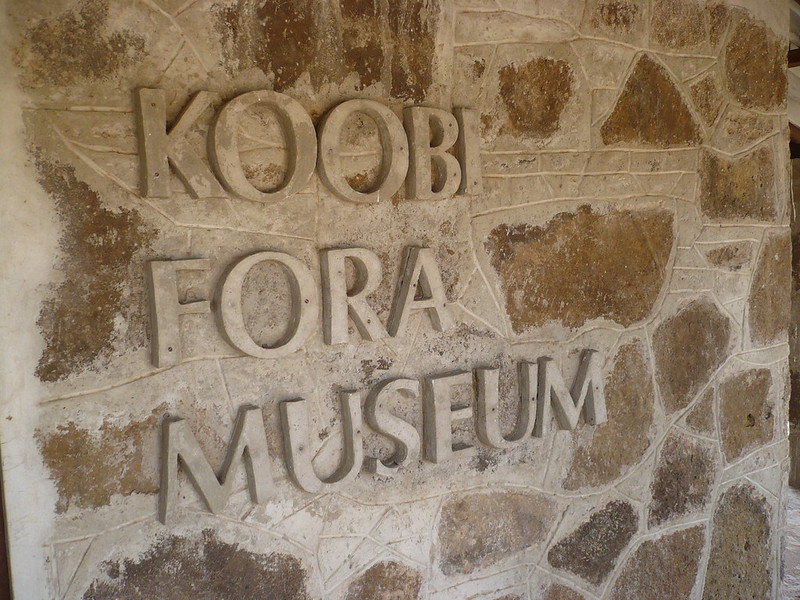
On the eastern shore of Lake Turkana in northern Kenya, the sandstone and siltstone layers of Koobi Fora hold sediments dating back as far as 4.2 million years. Researchers, including members of the Leakey family, have recovered fossils here from Australopithecus anamensis, Australopithecus boisei, Homo habilis, Homo rudolfensis, and Homo ergaster. Stone tools found nearby resemble the Oldowan technology first identified at Olduvai Gorge, which suggests a shared toolmaking tradition across the region. The name Koobi Fora itself comes from the Gabbra language, and it reflects the deep cultural roots of the communities who still live around Lake Turkana today. Beyond the fossils, the area rewards visitors with striking desert scenery and genuine encounters with Turkana and Gabbra communities, something Zamunda Travels often includes in its northern Kenya expeditions.
4. Gedi Ruins, Kenya — Kenya’s Vanished Swahili City
Deep within the Arabuko Sokoke Forest near Malindi, the Gedi Ruins tell one of East Africa’s strangest stories. This stone-built Swahili city flourished between the 13th and 17th centuries, protected by two concentric coral rag walls and centered on a palace complex, a Great Mosque, and elaborate coral tombs. Excavations have unearthed Chinese porcelain, Spanish coins, and Indian carnelian beads, which proves that Gedi traded across the Indian Ocean world despite its hidden inland location. Oddly, no historical document from the period ever mentions the city by name. Sometime in the early 17th century, residents abandoned Gedi entirely, and the forest swallowed it until British colonial officials rediscovered the ruins in 1884 and formally protected them in 1927. Archaeologists still debate why the population left, with theories ranging from water shortages to Portuguese pressure along the coast.
5. Lamu Old Town, Kenya — East Africa’s Best-Preserved Swahili Settlement
Lamu Old Town, on Kenya’s northern coast, holds the title of the oldest and best preserved Swahili settlement in East Africa. Builders constructed the town from coral stone and mangrove timber, and its narrow streets still showcase inner courtyards, shaded verandas, and intricately carved wooden doors. UNESCO added Lamu to its World Heritage list because the town has retained its traditional social and religious functions rather than becoming a museum piece. Since the 19th century, Lamu has hosted major Islamic festivals, and it remains a center for scholars studying Swahili and Islamic culture. Because cars are largely absent from the island, walking through Lamu feels like stepping directly into its centuries-old rhythm, an experience Zamunda Travels highlights on its coastal Kenya itineraries.
6. Kilwa Kisiwani, Tanzania — The Wealthiest Port on the Swahili Coast
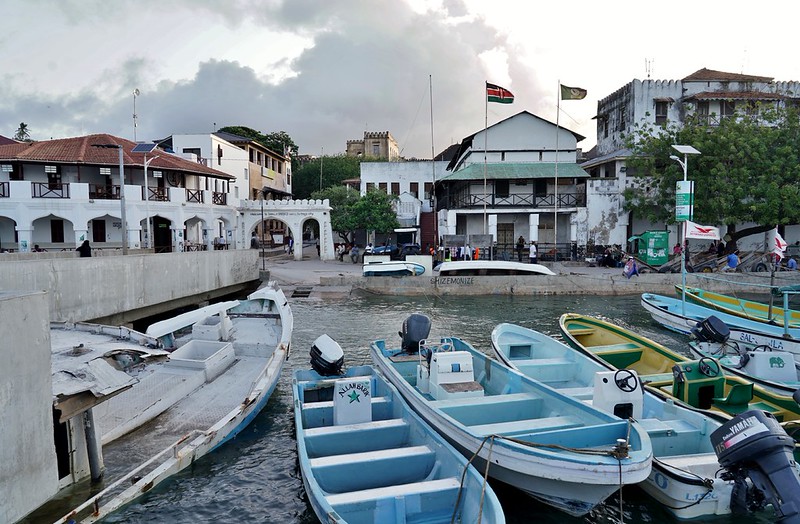
Kilwa Kisiwani, an island off southern Tanzania, once ranked as the single most important trading center on the East African coast. Founded around the 9th century by Persian and Arab settlers, the city reached its peak between the 13th and 15th centuries by controlling the gold trade that flowed from the Great Zimbabwe region to the Indian Ocean. Kilwa grew so wealthy that its rulers minted their own currency between the 11th and 14th centuries. Visitors today can explore the remains of the Great Mosque, a well preserved Omani fort, and the Husuni Kubwa palace, which was once the largest permanent building in sub Saharan Africa. UNESCO listed Kilwa Kisiwani alongside the neighboring ruins of Songo Mnara in 1981, recognizing both sites as essential evidence of Swahili civilization and Islamic influence along the coast.
7. Engaruka, Tanzania — An Ancient Engineering Marvel
Tucked against the Rift Valley escarpment near Lake Natron, Engaruka preserves one of precolonial Africa’s most sophisticated farming systems. Between the 15th and 18th centuries, a community likely descended from the ancestral Iraqw people built stone-lined canals, terraced fields, and cairns across more than 20 square kilometers of otherwise arid land. This irrigation network supported several thousand residents in an environment where farming would seem impossible today. German researcher Gustav Fischer first documented the ruins in 1883, and archaeologists, including Louis Leakey, later expanded the investigation. Trade goods such as cowrie shells and glass beads confirm that Engaruka’s farmers connected with merchants along the Swahili Coast. Around 1700, the community abandoned the site, possibly due to drought or territorial conflict, and the reason remains an open question for researchers today.
8. Aksum, Ethiopia — Capital of an Ancient Empire
In Ethiopia’s northern highlands, the ancient city of Aksum once ruled a kingdom powerful enough that a 3rd-century prophet named it one of the four great civilizations of the world. The Aksumite Kingdom rose to prominence by the 2nd century BCE and reached its height between the 3rd and 5th centuries AD, controlling trade routes linking Africa, Arabia, and the Mediterranean. Its most striking legacy is the field of carved granite stelae, some standing nearly 100 feet tall, which mark royal tombs beneath the surface. In the 4th century, King Ezana adopted Christianity, making Aksum one of the earliest Christian states in the world. The nearby Church of St. Mary of Zion holds special significance, since Ethiopian tradition names it as the resting place of the Ark of the Covenant.
9. Lalibela, Ethiopia — Eleven Churches Carved From Living Rock
Roughly 800 years ago, King Lalibela commissioned a project so ambitious that it still puzzles engineers today: eleven churches carved directly into red volcanic rock, intended as a new Jerusalem for Ethiopian Christians. Some archaeologists, including Cambridge professor David Phillipson, argue that portions of the site may date even earlier, to the 7th or 8th century. Regardless of the exact timeline, the churches remain functioning places of worship, and Ethiopian Orthodox pilgrims still gather here in huge numbers during major festivals such as Timkat and Genna. Structures like Biete Amanuel echo the architectural style of ancient Aksum, which shows a clear cultural link between the two UNESCO listed sites. Walking among the churches, many of which connect through tunnels and trenches carved from solid stone, remains one of the most humbling experiences among all the archaeological sites in East Africa.
10. Nyero Rock Paintings, Uganda — Ancient Art on the Rift’s Edge
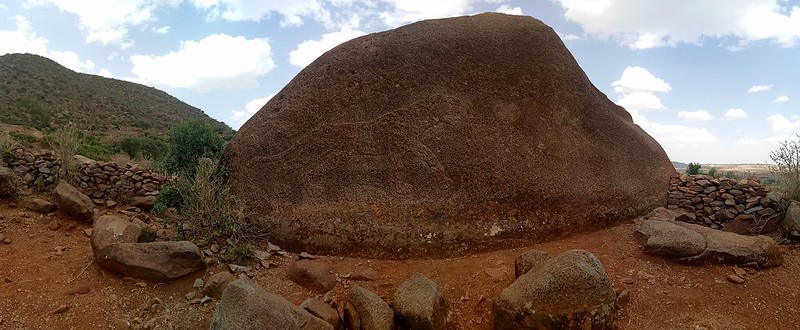
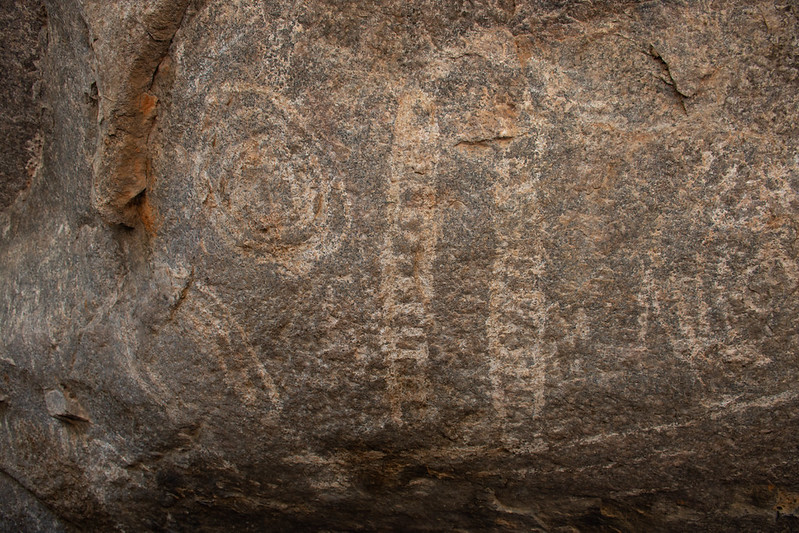
In eastern Uganda’s Kumi District, roughly eight kilometers from Kumi town, three granite rock shelters hold the Nyero Rock Paintings. Researchers estimate the geometric and symbolic artwork to be between 3,000 and 4,000 years old, making it one of Uganda’s oldest known cultural sites. The paintings include concentric circles, abstract geometric patterns, and figures such as a crocodile, which local tradition links to the dangers early communities faced from wildlife and rival groups. Because so few written records exist from this period, the rock art offers rare direct insight into how early inhabitants of the region communicated and understood their world. Nyero remains one of several rock art sites scattered across Uganda, and it pairs naturally with cultural tours through the country’s eastern region.
How to Plan a Trip Around These Sites
Visiting all ten locations in a single trip would require crossing four countries, so most travelers choose a themed route instead. A northern Tanzania circuit easily combines Olduvai Gorge, Laetoli, and Engaruka with wildlife viewing in the Serengeti and Ngorongoro Crater. A Kenyan coastal route links Koobi Fora’s desert landscapes with the Swahili ruins of Gedi and Lamu. Meanwhile, an Ethiopian historical circuit connects Aksum and Lalibela into one unforgettable journey through the country’s ancient Christian heartland. Zamunda Travels builds each of these routes around expert local guides, because context transforms a pile of stones into a genuinely moving experience. Furthermore, the right guide can explain not just what a site is, but why it still matters to the communities living around it today.
Frequently Asked Questions About Archaeological Sites in East Africa
Which East African country has the most archaeological sites?
Tanzania and Ethiopia both hold exceptional concentrations of historically significant sites. Tanzania anchors the story of human evolution through Olduvai Gorge, Laetoli, and Engaruka, while Ethiopia holds more UNESCO World Heritage Sites than almost any other African nation, including Aksum and Lalibela.
What is the best time of year to visit these sites?
Dry seasons generally offer the easiest travel conditions across the region. In Tanzania and Kenya, the months from June through October and January through February tend to bring clearer skies and better road access. In Ethiopia, the period from October through March provides the most reliable weather for exploring open air sites like Aksum’s stelae field.
Can travelers visit more than one country on a single trip?
Yes, and many travelers do exactly that. Regional flight networks connect Nairobi, Arusha, Addis Ababa, and Entebbe, which makes it realistic to combine sites across Kenya, Tanzania, Ethiopia, and Uganda. Zamunda Travels frequently designs multi country itineraries for guests who want the fuller picture of East Africa’s archaeological story.
Plan Your Journey to the Best Archaeological Sites in East Africa with Zamunda Travels
From the volcanic ash of Laetoli to the carved stone of Lalibela, the archaeological sites in East Africa tell a story that spans millions of years and dozens of civilizations. Each location adds a different chapter, whether it covers the origins of humankind, the rise of Swahili trading cities, or the birth of an ancient Christian kingdom. Rather than researching logistics site by site, travelers can rely on Zamunda Travels to handle permits, guides, and routing across borders. That way, the only thing left to do is stand in these remarkable places and let the history speak for itself.