Night Game Drive in Murchison Falls National Park
November 6, 2026
Why Queen Elizabeth National Park Is Called Queen Elizabeth National Park
November 6, 2026
Night walks in Kibale National Park offer a different way to experience Uganda’s famous tropical forest. While most visitors come for chimpanzee trekking, the forest also supports fascinating nocturnal wildlife.
After sunset, bushbabies move through the canopy, insects become more active, and unusual animal calls fill the forest. Meanwhile, experienced Uganda Wildlife Authority guides help visitors explore designated trails using spotlights.
At Zamunda Travels, we recommend this activity for travellers who enjoy wildlife, photography and quiet forest experiences. It also complements daytime chimpanzee trekking.
Quick answer: Night walks in Kibale National Park are guided evening forest excursions that focus on nocturnal wildlife. Visitors may encounter bushbabies, pottos, nightjars and other forest creatures. The experience generally lasts around two hours and requires an authorised guide. Wildlife sightings vary, and visitors should confirm schedules, fees and availability before travelling.
What Are Night Walks in Kibale National Park?
A night walk is a guided nature experience conducted after sunset inside Kibale National Park.
Unlike daytime chimpanzee trekking, the activity focuses on animals that become active after dark. These include nocturnal primates, small mammals, birds and insects.
Kibale lies in western Uganda, near Fort Portal. Its tropical forest supports 13 primate species and many other animals. Therefore, visitors can explore different aspects of the ecosystem during separate daytime and nighttime activities.
Night walks take place under the supervision of authorised park guides. Participants follow approved routes rather than exploring the forest independently.
Guides use spotlights to search branches, tree trunks and forest openings. They also listen for animal calls that help reveal wildlife locations.
However, a night walk is not simply about spotting animals. It also introduces visitors to forest sounds, nocturnal behaviour and the importance of protecting wildlife habitats.
Where do the night walks start?
Kanyanchu is Kibale’s main tourism centre and a recognised starting point for guided forest activities.
The UWA park brochure identifies evening walks between 7:30 pm and 10:00 pm. However, visitors should confirm their exact reporting time and meeting point before arrival.
Zamunda Travels recommends staying near Kanyanchu when planning this activity. A nearby lodge reduces unnecessary travel after dark.
Wildlife You Can See During Night Walks in Kibale
Nocturnal wildlife in Kibale includes animals that visitors rarely encounter during normal daytime activities.
Although sightings depend on luck and conditions, several species make the experience particularly interesting.
Bushbabies and galagos
Bushbabies are among the main attractions during a Kibale Forest night walk.
These small nocturnal primates have large eyes and powerful hind legs. They move between branches while searching for insects, fruit and other food.
Their eyes may reflect light from a guide’s spotlight. As a result, visitors sometimes notice them before seeing their bodies.
However, bushbabies move quickly and can disappear into dense vegetation.
Pottos
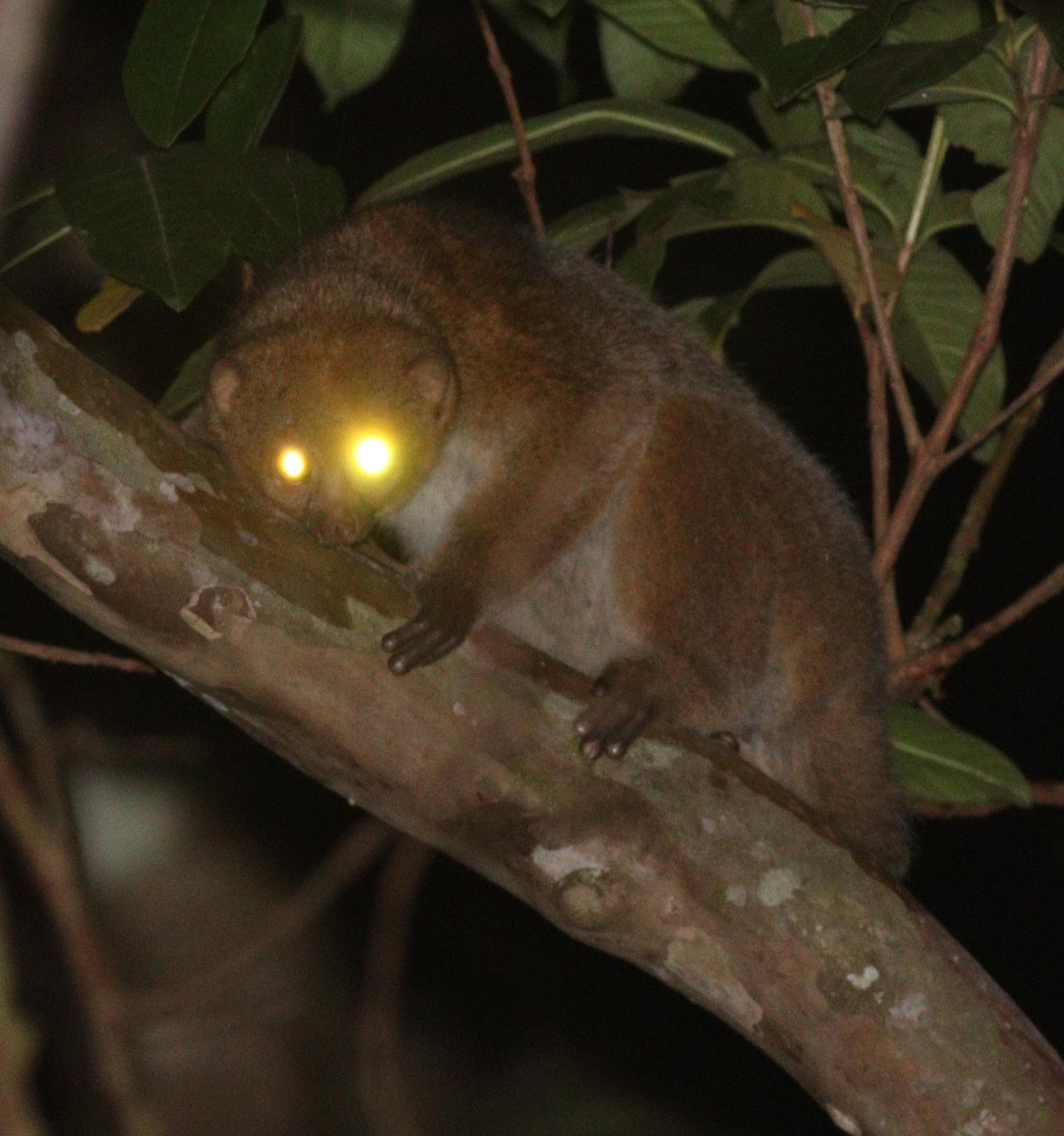
Pottos move slowly through forest branches after dark and are among the elusive primates associated with Kibale’s night walks.
Pottos are slow-moving nocturnal primates that live in forest trees.
Unlike bushbabies, they move carefully through branches and dense vegetation. Their cautious movements make them difficult to detect.
Seeing a potto is particularly rewarding for visitors interested in unusual African primates.
Nevertheless, sightings are never guaranteed.
Tree hyraxes and other mammals
Tree hyraxes are small, mainly nocturnal mammals known for their distinctive calls.
Visitors may hear their loud vocalisations without seeing the animals themselves.
Kibale also supports civets and other elusive mammals. However, many remain difficult to observe because of their secretive behaviour.
Nightjars, owls and insects
Nightjars are nocturnal birds that may appear along forest openings and trails.
Owls can also be heard or occasionally observed, depending on their location and activity.
Meanwhile, crickets, frogs and other small creatures create a continuous background of forest sounds.
These sounds help visitors appreciate the ecosystem even when larger animals remain concealed.
The wildlife commonly associated with Kibale’s night walks includes bushbabies, pottos, nightjars and tree hyraxes.
What to Expect During a Guided Kibale Forest Night Walk
The experience begins with preparations before entering the forest.
First, visitors report to the designated meeting point for registration and instructions.
The guide explains walking rules, wildlife behaviour and the importance of staying together.
Next, participants enter the forest along an approved trail.
Walking through the forest after dark
The forest feels different once natural daylight disappears.
Visitors hear insects, moving leaves and distant animal calls. Meanwhile, the guide uses a spotlight to inspect suitable wildlife habitats.
Walking is generally slower than a normal daytime hike. This allows the group to observe wildlife without unnecessary disturbance.
The guide may stop regularly to listen or investigate movement in the canopy.
However, participants should avoid making loud noises or using bright camera flashes.
How long does the experience take?
Allow approximately two hours for the guided walk, plus time for registration and transfers.
UWA’s older published schedule gives an evening operating window of 7:30 pm to 10:00 pm. Actual walking duration can vary.
Therefore, travellers should avoid scheduling late-night transfers immediately afterward.
Our guides at Zamunda Travels recommend arranging dinner with your lodge before departure or after returning.
How difficult is the walk?
A typical guided night walk involves forest paths, uneven ground and occasional muddy sections.
The activity does not usually require advanced hiking skills. However, visitors need reasonable mobility and confidence walking in darkness.
Rain can make exposed roots and slopes slippery.
For this reason, travellers with mobility limitations should discuss their needs before booking.
How Much Does a Kibale Night Walk Cost?
The Kibale night walk cost depends on the current Uganda Wildlife Authority tariff and the visitor’s residency category.
Different rates may apply to foreign non-residents, foreign residents and East African citizens.
For 2026, the published 2026–2028 UWA tariff reproduced online lists these night nature walk rates:
-
Foreign non-residents: USD 50 per person.
-
Foreign residents: USD 30 per person.
-
East African citizens: UGX 20,000 per person.
These figures come from a secondary copy of the tariff and require confirmation against the official UWA schedule before publication or booking.
Rates change, so confirm current prices with Zamunda Travels.
Additionally, confirm whether park entrance fees apply separately. Transport, accommodation and personal expenses may increase the total cost.
Example budget for two travellers
Consider two foreign non-resident adults already staying near Kibale.
At the provisional 2026 tariff, their night-walk activity fees would total USD 100.
However, this example excludes any separately payable entrance fees, lodge transfers and other expenses.
Zamunda Travels can prepare a quotation based on your nationality, accommodation and planned activities.
Best Time for Kibale Night Walks
The best time for Kibale night walks depends on weather conditions and personal preferences.
Kibale remains a tropical forest throughout the year. Therefore, rain can occur even during relatively dry months.
June to August and December to February
These months generally offer comparatively drier conditions in western Uganda.
Forest trails may be easier to navigate, especially after several rain-free days.
Consequently, travellers concerned about slippery paths may prefer these periods.
However, dry weather does not guarantee more wildlife sightings.
March to May and September to November
These periods generally receive more rainfall.
The forest becomes particularly green, while insects and amphibians may be more noticeable.
However, muddy paths and sudden showers can make walking less comfortable.
Heavy rain or unsafe conditions may also affect scheduled activities.
Therefore, visitors should remain flexible and follow the park authorities’ guidance.
What to Wear and Carry for a Night Walk
Proper clothing makes the experience safer and more comfortable.
Our guides at Zamunda Travels recommend preparing for damp ground, insects and changing temperatures.
Bring the following essentials:
-
Closed hiking shoes with reliable grip.
-
Long trousers and a lightweight long-sleeved shirt.
-
A light waterproof jacket.
-
Insect repellent.
-
A small water bottle.
-
A personal torch for emergencies, subject to guide instructions.
-
A camera suitable for low-light photography.
Neutral-coloured clothing is useful for forest activities. Meanwhile, comfortable footwear matters more than fashionable safari clothing.
Avoid carrying unnecessary equipment or heavy bags.
Photography tips
Night wildlife photography requires patience.
Small animals may appear briefly, often high in the trees. Therefore, a camera with good low-light performance is helpful.
However, avoid flash photography unless the guide specifically permits it.
Bright flashes can disturb nocturnal animals and affect other visitors.
Instead, observe the wildlife first and photograph only when conditions allow.
Are Night Walks in Kibale National Park Safe?
Guided night walks in Uganda can be enjoyable when visitors follow established park safety procedures.
However, Kibale remains a natural wildlife habitat, and darkness introduces additional risks.
Therefore, visitors should never enter the forest independently at night.
Important safety precautions
Always follow your authorised guide and remain on approved trails.
Additionally, avoid approaching wildlife, touching unfamiliar plants or leaving the group.
Forest elephants and other large mammals inhabit Kibale. Although the night walk focuses on smaller wildlife, guides must remain alert to their surroundings.
Visitors should also watch their footing and report discomfort immediately.
Health considerations
Mosquito bites, slippery surfaces and physical fatigue are practical concerns.
Use suitable insect repellent and wear protective clothing.
Travellers should also seek professional advice about malaria prevention and routine travel vaccinations before visiting Uganda.
If you have limited mobility, discuss accessibility with Zamunda Travels before confirming your reservation.
Combining Night Walks With Chimpanzee Trekking
Kibale chimpanzee trekking and night walk experiences complement each other.
During the day, visitors search for chimpanzees and other primates. At night, they explore a different side of the forest.
However, these are separate activities with different objectives and booking arrangements.
Example two-day Kibale itinerary
Day 1: Arrival and night walk
Travel from Fort Portal or another destination to your accommodation near Kibale.
After checking in, rest and enjoy an early dinner.
Later, transfer to the designated meeting point for the guided night walk.
Return to your lodge afterward.
Day 2: Chimpanzee trekking and Bigodi Wetland
Begin with a pre-booked chimpanzee trekking session.
Afterward, return for lunch and some rest.
If energy and timing permit, visit Bigodi Wetland Sanctuary for birdwatching and community-based nature activities.
This itinerary allows visitors to experience nocturnal wildlife, chimpanzees and wetland habitats.
However, avoid overloading the schedule if you prefer a relaxed safari.
For travellers interested in a longer Uganda adventure, Zamunda Travels can combine Kibale with Queen Elizabeth National Park and Bwindi Impenetrable National Park.
How to Get to Kibale National Park
Kibale National Park lies in western Uganda, within reach of Fort Portal.
According to UWA, the road journey from Kampala follows the Fort Portal route and covers approximately 326 kilometres. Driving takes around six hours under suitable conditions.
However, actual journey times depend on traffic, road conditions and stops.
From Fort Portal, allow roughly one hour to reach the park’s main tourism area.
Visitors can also combine Kibale with Queen Elizabeth National Park during a western Uganda safari.
Where should you stay?
Accommodation is available around Kanyanchu, Bigodi and the wider Fort Portal area.
For night walks, we recommend choosing accommodation with convenient access to the activity meeting point.
This reduces driving after dark and makes the evening more comfortable.
Zamunda Travels can recommend suitable accommodation according to your preferred budget and travel style.
Common Mistakes to Avoid During Kibale Night Walks
Many visitors focus on the wildlife but overlook simple planning details.
Avoiding these mistakes can improve the experience.
Expecting guaranteed animal sightings
Kibale is a natural forest, not a controlled wildlife enclosure.
Therefore, no guide can promise specific sightings.
Instead, enjoy the sounds, atmosphere and opportunity to observe nocturnal behaviour.
Wearing unsuitable shoes
Ordinary sandals and smooth-soled shoes provide limited protection on wet trails.
Choose comfortable footwear with good grip.
Arriving late
Night walks operate within scheduled time windows.
Consequently, late arrival may affect participation.
Arrange your transport and reporting time in advance.
Booking without checking current fees
Online travel websites sometimes display outdated tariffs.
Therefore, verify the latest UWA rates and any additional charges before payment.
Planning too many activities
Chimpanzee trekking, wetland walks and evening forest excursions require energy.
Allow enough time for meals, rest and transfers.
Why Book Your Kibale Night Walk With Zamunda Travels?
Zamunda Travels is a Uganda-based safari operator organising wildlife experiences across East Africa.
We help travellers plan guided activities, accommodation and transport around Kibale National Park.
Our team can also coordinate chimpanzee trekking, Bigodi Wetland visits and wider Uganda safari itineraries.
Most importantly, we help visitors understand the practical details before travelling.
These include activity schedules, suitable clothing, travel distances and applicable fees.
For a smoother experience, request a personalised Kibale safari quotation before confirming your travel dates.
Experience Kibale Forest After Dark
Night walks in Kibale National Park introduce visitors to wildlife that daytime excursions often miss.
From bushbabies and pottos to unusual forest sounds, the experience reveals another side of Uganda’s tropical ecosystem.
However, careful planning remains important. Choose suitable footwear, follow your guide and maintain realistic wildlife expectations.
At Zamunda Travels, we can help arrange your night walk alongside chimpanzee trekking and other Uganda safari experiences.
Plan your Kibale Forest adventure with Zamunda Travels.
Website: www.zamundatravels.com
Email: info@zamundatravels.com
WhatsApp: +256 704 705 606
Explore. Experience. Remember.
Frequently Asked Questions About Night Walks in Kibale
1. Can you do night walks in Kibale National Park?
Yes. Kibale National Park offers guided night walks focused on nocturnal wildlife. Visitors explore authorised forest trails with park guides and spotlights. The activity generally takes around two hours. However, operating schedules and availability can change, so confirm your preferred date and reporting time before travelling.
2. How much does a night walk in Kibale cost?
The cost depends on the current Uganda Wildlife Authority tariff and your residency category. A secondary copy of the 2026–2028 tariff lists USD 50 for foreign non-residents, subject to official confirmation. Additional park entrance or transport charges may apply. Rates change, so confirm current prices with Zamunda Travels.
3. What animals can you see during a Kibale night walk?
Visitors may see bushbabies, pottos, nightjars, tree hyraxes and other nocturnal wildlife. Guides also help identify animal calls and movements within the forest. However, sightings depend on weather, animal activity and luck. No particular species is guaranteed during a guided night walk.
4. Are night walks in Kibale safe?
Yes, guided night walks can be undertaken safely when visitors follow park instructions. Authorised guides understand the forest environment and approved walking routes. However, participants should wear suitable shoes, remain with their group and avoid approaching wildlife. Independent nighttime exploration inside the park is not recommended.
5. What is the best time for night walks in Kibale?
Night walks can be planned throughout the year, subject to park operations and weather conditions. The relatively dry months often provide more comfortable walking conditions. However, rainfall remains possible at any time. Wildlife activity also varies, so no particular month guarantees better nocturnal sightings.