Planning a safari in
Tanzania is exciting. However, comparing safari prices can quickly become confusing.
Two safari companies may offer similar itineraries but charge very different prices. One package might include accommodation, park fees, meals and game drives. Another might exclude important expenses.
Understanding
Tanzania safari quotes helps you avoid unexpected costs and choose the right safari experience.
At
Zamunda Travels, we help travellers plan East African safaris based on their budgets, interests and available time. This guide explains the costs you should check before booking.
Quick Answer: Tanzania safari quotes differ because operators include different accommodation, park fees, transport, meals and activities. Ngorongoro Crater charges and Serengeti overnight fees can increase the total. Before booking, compare travel dates, routes, lodge standards and inclusions. Always request a written breakdown of additional expenses.
Understanding Tanzania Safari Quotes and Their Main Costs
A Tanzania safari package combines several expenses. Some charges come from government authorities, while others depend on your tour operator.
Therefore, comparing only the advertised price can give you the wrong impression.
Most Tanzania safari quotations include the following cost categories:
| Cost category |
What you are paying for |
| National park fees |
Entry into protected national parks |
| Ngorongoro charges |
Conservation area entry and crater vehicle service |
| Accommodation |
Lodges, tented camps or campsites |
| Safari vehicle |
Transport, fuel and operating costs |
| Driver-guide |
Professional guiding and safari transport |
| Meals |
Breakfast, lunch, dinner and sometimes drinks |
| Overnight conservation charges |
Applicable concession or camping fees |
| Additional activities |
Balloon safaris, cultural visits or guided walks |
| Transfers |
Airport pickups, drop-offs and domestic flights |
A cheaper safari package might exclude several of these items. Meanwhile, a more expensive package may include nearly everything.
For example, one operator may arrange accommodation outside Serengeti National Park. Another may book a lodge inside the park.
Both itineraries might mention the Serengeti. However, the accommodation locations can affect your wildlife-viewing time.
At Zamunda Travels, we recommend comparing the complete itinerary rather than the advertised daily price.
What Is Included in a Tanzania Safari?
Most
safari packages explain accommodation, transport, meals and game drives.
However, inclusions vary between operators. Some companies also include airport transfers, bottled drinking water and conservation charges.
Before booking, confirm whether your package includes:
- A private or shared safari vehicle
- A professional driver-guide
- Accommodation and meals
- All scheduled national park fees
- Ngorongoro Crater vehicle service charges
- Applicable overnight concession fees
- Airport transfers
- Scheduled game drives
- Drinking water during safari activities
- Government taxes
Also, ask whether the quotation includes all applicable taxes.
This prevents confusion when comparing different operators.
Tanzania National Park Fees Explained
Tanzania has several famous wildlife destinations. These include Serengeti, Tarangire, Lake Manyara and Nyerere national parks.
The
Tanzania National Parks Authority, known as TANAPA, manages national park fees.
Meanwhile, the
Ngorongoro Conservation Area Authority manages its own conservation charges.
These authorities use different tariff structures. Therefore, operators must calculate the relevant fees for each itinerary.
Park entry charges generally depend on the visitor category, age, destination and applicable tariff period.
For example, non-resident international travellers usually pay different rates from qualifying East African Community citizens.
Children may also qualify for reduced rates.
Tanzania National Park Fee Reference
The following figures are published planning references for the 2025–2026 tariff period. They are not independently confirmed as the current October 2026 gate rates.
These published calculations include 18% VAT. However, the applicable tariff depends on travel dates and visitor categories.
Rates change, so confirm current prices with Zamunda Travels.
Before paying for your safari, ask your operator to confirm the official fees for your travel dates.
Also, check whether the itinerary requires additional park-entry periods.
A safari covering several national parks will usually have higher total conservation charges than a single-park trip.
Ngorongoro Crater Fees and Why They Matter
The Ngorongoro Crater is one of Tanzania’s best-known wildlife destinations.
Visitors may see buffaloes, zebras, wildebeest, lions and other animals. Black rhinos also inhabit the crater, although sightings are never guaranteed.
However, visiting Ngorongoro involves more than one type of charge.
First, travellers pay the applicable
Ngorongoro Conservation Area entry fee.
Next, safari vehicles descending into the crater pay a separate crater service fee.
This distinction matters when comparing safari quotations.
How Much Is the Ngorongoro Crater Fee?
Published 2026 calculations commonly show a crater vehicle service charge of US$295, including 18% VAT.
This is a vehicle charge rather than a separate charge for every passenger.
For example, consider two travellers sharing one safari vehicle.
The US$295 vehicle charge would equal US$147.50 per traveller.
If four travellers share the vehicle, the same charge would equal US$73.75 per person.
These calculations exclude individual conservation area entry fees and other applicable charges.
Consequently, travelling in a larger group can reduce the crater vehicle cost per person.
However, the group must remain within the vehicle’s approved passenger capacity.
Rates change, so confirm current prices with Zamunda Travels.
Always check whether your safari quotation includes both conservation area entry and crater vehicle service charges.
Serengeti Concession Fees and Overnight Charges
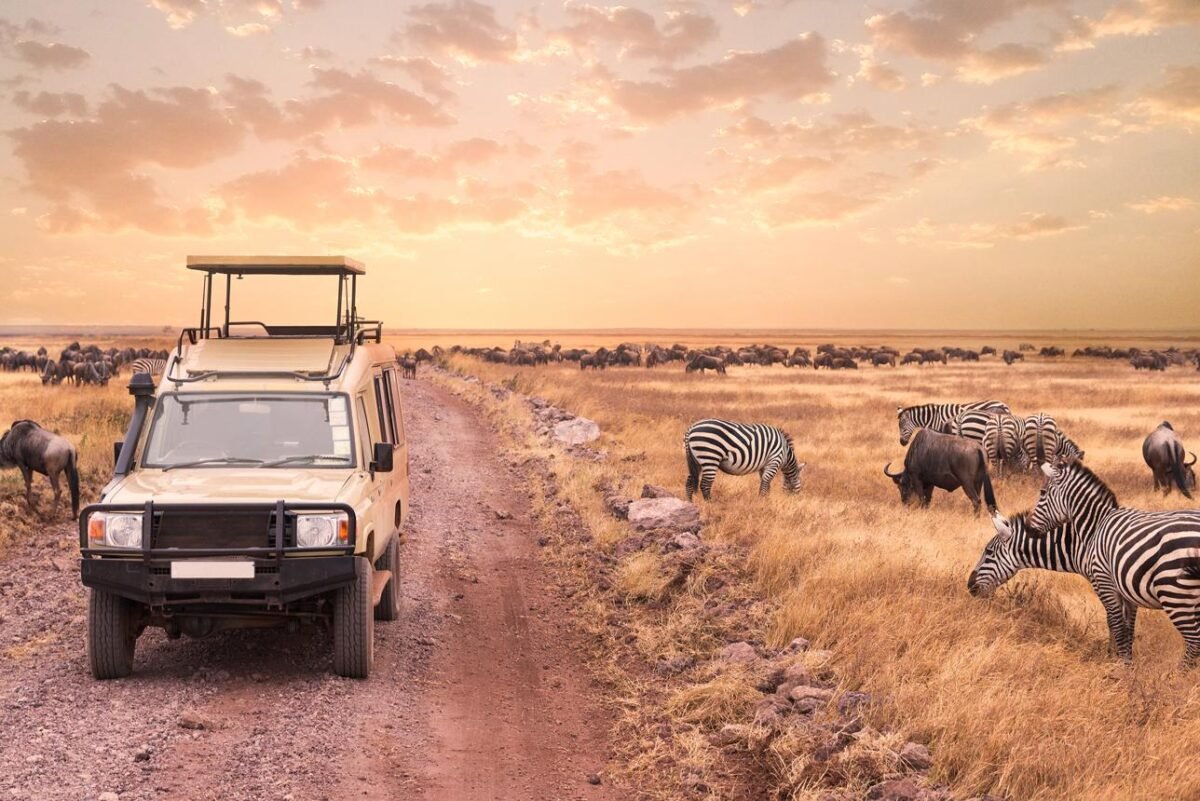
The Serengeti offers excellent opportunities to see lions, elephants, giraffes, cheetahs and large grazing herds.
However, accommodation inside the national park may involve additional conservation charges.
These are often called concession fees. Camping arrangements may involve separate camping charges.
They are not necessarily included in the lodge’s advertised room rate.
For example, a lodge might advertise a nightly accommodation price. However, the final safari cost may also include a conservation charge for staying inside the park.
These charges can vary according to accommodation type, visitor category and applicable tariff.
Therefore, always ask whether the quotation includes every relevant overnight fee.
Staying Inside or Outside the Serengeti
Accommodation location affects both price and safari time.
Staying inside the park can reduce daily travel between your lodge and wildlife areas.
It may also allow more convenient early morning game drives.
Meanwhile, staying outside may reduce certain accommodation or overnight conservation costs.
However, additional driving and park entry arrangements can offset some savings.
For short safaris, Zamunda Travels recommends considering the value of time inside the park.
A cheaper room is not always the better choice when it reduces your wildlife-viewing hours.
Comparing Two Tanzania Safari Quotes
Consider two hypothetical five-day safari quotations for two adults.
Both include Tarangire, Serengeti and Ngorongoro. However, their inclusions differ.
| Package feature |
Quote A |
Quote B |
| Accommodation |
Budget lodges outside some parks |
Mid-range lodges, including inside Serengeti |
| Transport |
Shared safari vehicle |
Private safari vehicle |
| Meals |
Selected meals |
Full board during safari |
| Park fees |
Some charges excluded |
Scheduled charges included |
| Crater service |
Additional payment |
Included |
| Airport transfers |
Additional payment |
Included |
| Game drives |
Fixed shared schedule |
Private scheduled game drives |
These are hypothetical package structures, not actual operator quotations.
Quote A might appear cheaper initially. However, additional payments could increase the final amount.
Quote B might cost more but provide greater flexibility and convenience.
Therefore, the best option depends on your budget and preferred safari experience.
Example: How Hidden Extras Affect Your Safari Budget
Consider a hypothetical safari advertised at US$2,000 per person.
Suppose the operator excludes US$300 in applicable fees and US$100 in transfers and meals.
The final amount becomes US$2,400 per person.
These figures are illustrative, not actual Tanzania safari market quotations.
This example shows why travellers should compare the final payable amount.
At Zamunda Travels, we encourage travellers to request a detailed quotation before making a deposit.
A clear comparison helps prevent misunderstandings later.
A private safari gives your group exclusive use of its safari vehicle and guide.
Therefore, you can usually enjoy greater flexibility within the agreed itinerary.
For example, your guide may spend more time watching a lion pride or photographing elephants.
A shared safari follows a group schedule. Consequently, individual travellers have less control over stops and departure times.
However, sharing vehicle costs can reduce the price per person.
Private safaris often suit couples, families and photographers who value flexibility.
Shared safaris may suit solo travellers and people with tighter budgets.
Before booking, ask about passenger numbers, vehicle seating and guaranteed window access.
Also, check whether everyone shares the same accommodation standard.
Tanzania Safari Hidden Costs to Check Before Booking
Some safari expenses are easy to overlook.
For example, international flights are commonly excluded from land safari packages.
Other possible extras include:
- Tanzania visa fees, where applicable
- Travel insurance and medical evacuation cover
- Driver-guide tips
- Alcoholic drinks and selected beverages
- Laundry services
- Hot-air balloon safaris
- Optional Maasai cultural visits
- Domestic flights and baggage charges
- Personal shopping and souvenirs
- Additional accommodation before or after the safari
Not every operator excludes these items. Therefore, ask for written confirmation.
Also, review the payment schedule and cancellation policy.
Check whether the operator can adjust prices if government tariffs change before travel.
Finally, confirm the quotation currency and any bank transfer charges.
These small details can make a significant difference to your total budget.
Sample Five-Day Northern Tanzania Safari
A realistic itinerary helps you understand how transport, accommodation and conservation fees combine.
Here is a possible five-day northern Tanzania safari.
Day 1: Arusha to Tarangire National Park
Travel from Arusha to Tarangire National Park for a game drive.
Look for elephants, giraffes, zebras and other wildlife.
Afterwards, continue to your accommodation near Tarangire or Karatu.
Day 2: Transfer to Serengeti National Park
Travel through the Ngorongoro Conservation Area toward Serengeti National Park.
Enjoy wildlife viewing when time allows.
Overnight inside the Serengeti.
Day 3: Full-Day Serengeti Game Drives
Spend the day exploring Serengeti wildlife areas.
Your guide will choose routes according to road conditions and animal movements.
Enjoy a picnic lunch or another meal arrangement included in your package.
Overnight inside the Serengeti.
Day 4: Serengeti to Karatu
Enjoy a morning game drive before travelling toward Karatu.
This journey involves substantial driving, so allow enough time.
Overnight in Karatu.
Day 5: Ngorongoro Crater and Arusha
Leave early for a crater game drive.
Look for lions, buffaloes, zebras and other wildlife.
Afterwards, return to Arusha, allowing sufficient time for the journey.
This itinerary is busy, especially on transfer days.
Therefore, travellers seeking a slower pace may prefer six or seven days.
Also, airport departure timing should allow for road delays.
How Seasons Affect Tanzania Safari Prices
Tanzania safari prices change throughout the year.
The northern safari circuit is popular during the dry season, especially from June through October.
July and August often attract strong demand for Serengeti accommodation.
Consequently, some lodges charge higher prices during these months.
The longer rainy period commonly falls around March through May. However, rainfall varies by location and year.
Some lodges offer lower rates during quieter periods.
Wildlife viewing remains possible throughout the year, although weather and road conditions can affect game drives.
The Great Migration also moves seasonally.
Therefore, travellers should choose their Serengeti location according to their wildlife interests.
At Zamunda Travels, we recommend booking early for popular travel periods.
However, flexible dates may help travellers find better accommodation value.
Practical Tips Before Accepting a Tanzania Safari Quote
A good safari quotation should explain exactly what you are buying.
First, request the names and locations of all accommodation properties.
Next, confirm whether the operator provides a private or shared vehicle.
Also, ask how many hours you can reasonably expect to spend on game drives.
Review the itinerary carefully for long transfer days.
For example, travelling from Arusha to central Serengeti by road takes much of the day.
Therefore, a package advertised as five safari days may include fewer full wildlife-viewing days.
Before making payment, request a written booking confirmation. It should identify the operator, payment terms and cancellation conditions.
Also, confirm whether the quoted accommodation is available for your travel dates.
If a lodge becomes unavailable, ask what replacement standard the operator will provide.
Finally, keep copies of payment receipts and booking correspondence.
Safety and Health Considerations
Travel insurance should cover safari activities, medical treatment and emergency evacuation where appropriate.
Also, consult a qualified travel health professional about malaria prevention and recommended vaccinations.
Yellow fever entry requirements depend on your travel history and applicable regulations.
During game drives, follow your guide’s instructions. Never leave the vehicle in unsafe areas.
Carry sunscreen, a hat, drinking water and any essential medication.
Finally, avoid itineraries that require unrealistic driving schedules.
How to Compare Tanzania Safari Quotes Before Booking
Comparing safari packages becomes easier when you follow a clear process.
First, request quotations for the same travel dates and number of travellers.
Next, compare the destinations, accommodation standards and number of nights.
Then, check whether each operator includes government conservation charges.
Afterwards, compare vehicle arrangements, meals, airport transfers and optional activities.
Finally, calculate the total amount payable, including excluded expenses.
This approach helps you identify the package offering better value.
Remember that the cheapest safari is not necessarily the most suitable.
A well-planned itinerary should balance cost, comfort, travel time and wildlife-viewing opportunities.
Conclusion: Choose Value, Not Just the Lowest Price
Comparing
Tanzania safari quotes requires more than checking the final amount.
Park fees, crater charges, accommodation, transport and optional activities all affect the total.
Therefore, a well-explained quotation gives you greater confidence before booking.
At Zamunda Travels, we help travellers compare safari options and plan suitable East African itineraries.
Whether you prefer a private wildlife safari or a more affordable shared experience, we can help you explore your options.
Request Your Tanzania Safari Quotation from Zamunda Travels
Website:
www.zamundatravels.com
Email:
info@zamundatravels.com
WhatsApp: +256 704 705 606
Frequently Asked Questions About Tanzania Safari Quotes
1. How much does a Tanzania safari cost per person?
Tanzania safari costs depend on travel duration, accommodation, group size and season. Private safaris usually cost more per person than shared trips. Serengeti and Ngorongoro itineraries also involve substantial conservation charges. Therefore, request a personalised quotation covering accommodation, transport, meals and all scheduled park fees.
2. Are national park fees included in Tanzania safari packages?
Many Tanzania safari packages include national park fees, but this is not guaranteed. Some operators advertise prices without certain conservation charges. Therefore, check the inclusions carefully before booking. Ask whether the price covers every scheduled park entry period, overnight concession charge and relevant Ngorongoro fee.
3. How much is the Ngorongoro Crater entry fee?
Ngorongoro has separate conservation area entry and crater vehicle service charges. Published 2026 calculations commonly show US$295 including VAT for the crater vehicle service. Individual entry fees are additional. However, tariff categories and applicable charges can change. Rates change, so confirm current prices with Zamunda Travels.
4. Why are Tanzania safari quotes so different?
Safari quotes differ because operators use different lodges, vehicles, routes and meal arrangements. Some packages include all scheduled conservation fees, while others exclude certain charges. Group size and travel season also influence pricing. Therefore, compare identical dates, accommodation standards, transport arrangements and inclusions before choosing.
5. Is a private Tanzania safari worth the extra cost?
A private safari can offer better flexibility, especially for couples, families and photographers. Travellers can usually adjust wildlife-viewing stops within the agreed itinerary. However, shared safaris may provide better value for budget-conscious visitors. The right choice depends on your priorities, group size and preferred travel experience.
Park Fees, Crater Charges and Extras
Planning a safari in Tanzania is exciting. However, comparing safari prices can quickly become confusing.
Two safari companies may offer similar itineraries but charge very different prices. One package might include accommodation, park fees, meals and game drives. Another might exclude important expenses.
Understanding
Tanzania safari quotes helps you avoid unexpected costs and choose the right safari experience.
At Zamunda Travels, we help travellers plan East African safaris based on their budgets, interests and available time. This guide explains the costs you should check before booking.
Quick Answer: Tanzania safari quotes differ because operators include different accommodation, park fees, transport, meals and activities. Ngorongoro Crater charges and Serengeti overnight fees can increase the total. Before booking, compare travel dates, routes, lodge standards and inclusions. Always request a written breakdown of additional expenses.
Understanding Tanzania Safari Quotes and Their Main Costs
A Tanzania safari package combines several expenses. Some charges come from government authorities, while others depend on your tour operator.
Therefore, comparing only the advertised price can give you the wrong impression.
Most Tanzania safari quotations include the following cost categories:
| Cost category |
What you are paying for |
| National park fees |
Entry into protected national parks |
| Ngorongoro charges |
Conservation area entry and crater vehicle service |
| Accommodation |
Lodges, tented camps or campsites |
| Safari vehicle |
Transport, fuel and operating costs |
| Driver-guide |
Professional guiding and safari transport |
| Meals |
Breakfast, lunch, dinner and sometimes drinks |
| Overnight conservation charges |
Applicable concession or camping fees |
| Additional activities |
Balloon safaris, cultural visits or guided walks |
| Transfers |
Airport pickups, drop-offs and domestic flights |
A cheaper safari package might exclude several of these items. Meanwhile, a more expensive package may include nearly everything.
For example, one operator may arrange accommodation outside Serengeti National Park. Another may book a lodge inside the park.
Both itineraries might mention the Serengeti. However, the accommodation locations can affect your wildlife-viewing time.
At Zamunda Travels, we recommend comparing the complete itinerary rather than the advertised daily price.
What Is Included in a Tanzania Safari?
Most safari packages explain accommodation, transport, meals and game drives.
However, inclusions vary between operators. Some companies also include airport transfers, bottled drinking water and conservation charges.
Before booking, confirm whether your package includes:
- A private or shared safari vehicle
- A professional driver-guide
- Accommodation and meals
- All scheduled national park fees
- Ngorongoro Crater vehicle service charges
- Applicable overnight concession fees
- Airport transfers
- Scheduled game drives
- Drinking water during safari activities
- Government taxes
Also, ask whether the quotation includes all applicable taxes.
This prevents confusion when comparing different operators.
Tanzania National Park Fees Explained
Tanzania has several famous wildlife destinations. These include Serengeti, Tarangire, Lake Manyara and Nyerere national parks.
The Tanzania National Parks Authority, known as TANAPA, manages national park fees.
Meanwhile, the Ngorongoro Conservation Area Authority manages its own conservation charges.
These authorities use different tariff structures. Therefore, operators must calculate the relevant fees for each itinerary.
Park entry charges generally depend on the visitor category, age, destination and applicable tariff period.
For example, non-resident international travellers usually pay different rates from qualifying East African Community citizens.
Children may also qualify for reduced rates.
Tanzania National Park Fee Reference
The following figures are published planning references for the 2025–2026 tariff period. They are not independently confirmed as the current October 2026 gate rates.
| National park |
Published adult non-resident reference |
| Serengeti National Park |
US$82.60 during peak season |
| Serengeti National Park |
US$70.80 during the lower tariff season |
| Tarangire National Park |
US$59.00 standard-season reference |
| Lake Manyara National Park |
US$59.00 standard-season reference |
These published calculations include 18% VAT. However, the applicable tariff depends on travel dates and visitor categories.
Rates change, so confirm current prices with Zamunda Travels.
Before paying for your safari, ask your operator to confirm the official fees for your travel dates.
Also, check whether the itinerary requires additional park-entry periods.
A safari covering several national parks will usually have higher total conservation charges than a single-park trip.
Ngorongoro Crater Fees and Why They Matter
The Ngorongoro Crater is one of Tanzania’s best-known wildlife destinations.
Visitors may see buffaloes, zebras, wildebeest, lions and other animals. Black rhinos also inhabit the crater, although sightings are never guaranteed.
However, visiting Ngorongoro involves more than one type of charge.
First, travellers pay the applicable Ngorongoro Conservation Area entry fee.
Next, safari vehicles descending into the crater pay a separate crater service fee.
This distinction matters when comparing safari quotations.
How Much Is the Ngorongoro Crater Fee?
Published 2026 calculations commonly show a crater vehicle service charge of US$295, including 18% VAT.
This is a vehicle charge rather than a separate charge for every passenger.
For example, consider two travellers sharing one safari vehicle.
The US$295 vehicle charge would equal US$147.50 per traveller.
If four travellers share the vehicle, the same charge would equal US$73.75 per person.
These calculations exclude individual conservation area entry fees and other applicable charges.
Consequently, travelling in a larger group can reduce the crater vehicle cost per person.
However, the group must remain within the vehicle’s approved passenger capacity.
Rates change, so confirm current prices with Zamunda Travels.
Always check whether your safari quotation includes both conservation area entry and crater vehicle service charges.
Serengeti Concession Fees and Overnight Charges
The Serengeti offers excellent opportunities to see lions, elephants, giraffes, cheetahs and large grazing herds.
However, accommodation inside the national park may involve additional conservation charges.
These are often called concession fees. Camping arrangements may involve separate camping charges.
They are not necessarily included in the lodge’s advertised room rate.
For example, a lodge might advertise a nightly accommodation price. However, the final safari cost may also include a conservation charge for staying inside the park.
These charges can vary according to accommodation type, visitor category and applicable tariff.
Therefore, always ask whether the quotation includes every relevant overnight fee.
Staying Inside or Outside the Serengeti
Accommodation location affects both price and safari time.
Staying inside the park can reduce daily travel between your lodge and wildlife areas.
It may also allow more convenient early morning game drives.
Meanwhile, staying outside may reduce certain accommodation or overnight conservation costs.
However, additional driving and park entry arrangements can offset some savings.
For short safaris, Zamunda Travels recommends considering the value of time inside the park.
A cheaper room is not always the better choice when it reduces your wildlife-viewing hours.
Comparing Two Tanzania Safari Quotes
Consider two hypothetical five-day safari quotations for two adults.
Both include Tarangire, Serengeti and Ngorongoro. However, their inclusions differ.
| Package feature |
Quote A |
Quote B |
| Accommodation |
Budget lodges outside some parks |
Mid-range lodges, including inside Serengeti |
| Transport |
Shared safari vehicle |
Private safari vehicle |
| Meals |
Selected meals |
Full board during safari |
| Park fees |
Some charges excluded |
Scheduled charges included |
| Crater service |
Additional payment |
Included |
| Airport transfers |
Additional payment |
Included |
| Game drives |
Fixed shared schedule |
Private scheduled game drives |
These are hypothetical package structures, not actual operator quotations.
Quote A might appear cheaper initially. However, additional payments could increase the final amount.
Quote B might cost more but provide greater flexibility and convenience.
Therefore, the best option depends on your budget and preferred safari experience.
Example: How Hidden Extras Affect Your Safari Budget
Consider a hypothetical safari advertised at US$2,000 per person.
Suppose the operator excludes US$300 in applicable fees and US$100 in transfers and meals.
The final amount becomes US$2,400 per person.
These figures are illustrative, not actual Tanzania safari market quotations.
This example shows why travellers should compare the final payable amount.
At Zamunda Travels, we encourage travellers to request a detailed quotation before making a deposit.
A clear comparison helps prevent misunderstandings later.
Private vs Shared Tanzania Safari: Which Offers Better Value?
A private safari gives your group exclusive use of its safari vehicle and guide.
Therefore, you can usually enjoy greater flexibility within the agreed itinerary.
For example, your guide may spend more time watching a lion pride or photographing elephants.
A shared safari follows a group schedule. Consequently, individual travellers have less control over stops and departure times.
However, sharing vehicle costs can reduce the price per person.
Private safaris often suit couples, families and photographers who value flexibility.
Shared safaris may suit solo travellers and people with tighter budgets.
Before booking, ask about passenger numbers, vehicle seating and guaranteed window access.
Also, check whether everyone shares the same accommodation standard.
Tanzania Safari Hidden Costs to Check Before Booking
Some safari expenses are easy to overlook.
For example, international flights are commonly excluded from land safari packages.
Other possible extras include:
- Tanzania visa fees, where applicable
- Travel insurance and medical evacuation cover
- Driver-guide tips
- Alcoholic drinks and selected beverages
- Laundry services
- Hot-air balloon safaris
- Optional Maasai cultural visits
- Domestic flights and baggage charges
- Personal shopping and souvenirs
- Additional accommodation before or after the safari
Not every operator excludes these items. Therefore, ask for written confirmation.
Also, review the payment schedule and cancellation policy.
Check whether the operator can adjust prices if government tariffs change before travel.
Finally, confirm the quotation currency and any bank transfer charges.
These small details can make a significant difference to your total budget.
Sample Five-Day Northern Tanzania Safari
A realistic itinerary helps you understand how transport, accommodation and conservation fees combine.
Here is a possible five-day northern Tanzania safari.
Day 1: Arusha to Tarangire National Park
Travel from Arusha to Tarangire National Park for a game drive.
Look for elephants, giraffes, zebras and other wildlife.
Afterwards, continue to your accommodation near Tarangire or Karatu.
Day 2: Transfer to Serengeti National Park
Travel through the Ngorongoro Conservation Area toward Serengeti National Park.
Enjoy wildlife viewing when time allows.
Overnight inside the Serengeti.
Day 3: Full-Day Serengeti Game Drives
Spend the day exploring Serengeti wildlife areas.
Your guide will choose routes according to road conditions and animal movements.
Enjoy a picnic lunch or another meal arrangement included in your package.
Overnight inside the Serengeti.
Day 4: Serengeti to Karatu
Enjoy a morning game drive before travelling toward Karatu.
This journey involves substantial driving, so allow enough time.
Overnight in Karatu.
Day 5: Ngorongoro Crater and Arusha
Leave early for a crater game drive.
Look for lions, buffaloes, zebras and other wildlife.
Afterwards, return to Arusha, allowing sufficient time for the journey.
This itinerary is busy, especially on transfer days.
Therefore, travellers seeking a slower pace may prefer six or seven days.
Also, airport departure timing should allow for road delays.
How Seasons Affect Tanzania Safari Prices
Tanzania safari prices change throughout the year.
The northern safari circuit is popular during the dry season, especially from June through October.
July and August often attract strong demand for Serengeti accommodation.
Consequently, some lodges charge higher prices during these months.
The longer rainy period commonly falls around March through May. However, rainfall varies by location and year.
Some lodges offer lower rates during quieter periods.
Wildlife viewing remains possible throughout the year, although weather and road conditions can affect game drives.
The Great Migration also moves seasonally.
Therefore, travellers should choose their Serengeti location according to their wildlife interests.
At Zamunda Travels, we recommend booking early for popular travel periods.
However, flexible dates may help travellers find better accommodation value.
Practical Tips Before Accepting a Tanzania Safari Quote
A good safari quotation should explain exactly what you are buying.
First, request the names and locations of all accommodation properties.
Next, confirm whether the operator provides a private or shared vehicle.
Also, ask how many hours you can reasonably expect to spend on game drives.
Review the itinerary carefully for long transfer days.
For example, travelling from Arusha to central Serengeti by road takes much of the day.
Therefore, a package advertised as five safari days may include fewer full wildlife-viewing days.
Before making payment, request a written booking confirmation. It should identify the operator, payment terms and cancellation conditions.
Also, confirm whether the quoted accommodation is available for your travel dates.
If a lodge becomes unavailable, ask what replacement standard the operator will provide.
Finally, keep copies of payment receipts and booking correspondence.
Safety and Health Considerations
Travel insurance should cover safari activities, medical treatment and emergency evacuation where appropriate.
Also, consult a qualified travel health professional about malaria prevention and recommended vaccinations.
Yellow fever entry requirements depend on your travel history and applicable regulations.
During game drives, follow your guide’s instructions. Never leave the vehicle in unsafe areas.
Carry sunscreen, a hat, drinking water and any essential medication.
Finally, avoid itineraries that require unrealistic driving schedules.
How to Compare Tanzania Safari Quotes Before Booking
Comparing safari packages becomes easier when you follow a clear process.
First, request quotations for the same travel dates and number of travellers.
Next, compare the destinations, accommodation standards and number of nights.
Then, check whether each operator includes government conservation charges.
Afterwards, compare vehicle arrangements, meals, airport transfers and optional activities.
Finally, calculate the total amount payable, including excluded expenses.
This approach helps you identify the package offering better value.
Remember that the cheapest safari is not necessarily the most suitable.
A well-planned itinerary should balance cost, comfort, travel time and wildlife-viewing opportunities.
Choose Value, Not Just the Lowest Price
Comparing
Tanzania safari quotes requires more than checking the final amount.
Park fees, crater charges, accommodation, transport and optional activities all affect the total.
Therefore, a well-explained quotation gives you greater confidence before booking.
At Zamunda Travels, we help travellers compare safari options and plan suitable East African itineraries.
Whether you prefer a private wildlife safari or a more affordable shared experience, we can help you explore your options.
Request Your Tanzania Safari Quotation from Zamunda Travels
Website:
www.zamundatravels.com
Email:
info@zamundatravels.com
WhatsApp: +256 704 705 606
Frequently Asked Questions About Tanzania Safari Quotes
1. How much does a Tanzania safari cost per person?
Tanzania safari costs depend on travel duration, accommodation, group size and season. Private safaris usually cost more per person than shared trips. Serengeti and Ngorongoro itineraries also involve substantial conservation charges. Therefore, request a personalised quotation covering accommodation, transport, meals and all scheduled park fees.
2. Are national park fees included in Tanzania safari packages?
Many Tanzania safari packages include national park fees, but this is not guaranteed. Some operators advertise prices without certain conservation charges. Therefore, check the inclusions carefully before booking. Ask whether the price covers every scheduled park entry period, overnight concession charge and relevant Ngorongoro fee.
3. How much is the Ngorongoro Crater entry fee?
Ngorongoro has separate conservation area entry and crater vehicle service charges. Published 2026 calculations commonly show US$295 including VAT for the crater vehicle service. Individual entry fees are additional. However, tariff categories and applicable charges can change. Rates change, so confirm current prices with Zamunda Travels.
4. Why are Tanzania safari quotes so different?
Safari quotes differ because operators use different lodges, vehicles, routes and meal arrangements. Some packages include all scheduled conservation fees, while others exclude certain charges. Group size and travel season also influence pricing. Therefore, compare identical dates, accommodation standards, transport arrangements and inclusions before choosing.
5. Is a private Tanzania safari worth the extra cost?
A private safari can offer better flexibility, especially for couples, families and photographers. Travellers can usually adjust wildlife-viewing stops within the agreed itinerary. However, shared safaris may provide better value for budget-conscious visitors. The right choice depends on your priorities, group size and preferred travel experience.